
Feature Learning and Transfer Learning
Last updated on 2026-04-15 | Edit this page
Estimated time: 50 minutes
Overview
Questions
- What does it mean for a model to learn features automatically?
- When is transfer learning more realistic than training from scratch?
- How should representation and data type guide the next modelling step?
Objectives
- Explain feature learning in plain language.
- Distinguish between conventional feature engineering and learned representations.
- Identify cases where transfer learning or specialised architectures are a more realistic next step than training a deep model from scratch.
From engineered features to learned representations
In conventional machine learning, people usually decide which features the model should use. In feature learning, the model learns internal representations automatically from the training data.
This lesson is about what you do with that idea in practice, especially when you do not want to train a large deep model from scratch.
Learned representations can arise in more than one way:
- in supervised learning, the internal features are shaped by a task label such as a class or target value;
- in self-supervised learning, the model learns useful internal structure from the input itself, for example by predicting masked or missing parts.
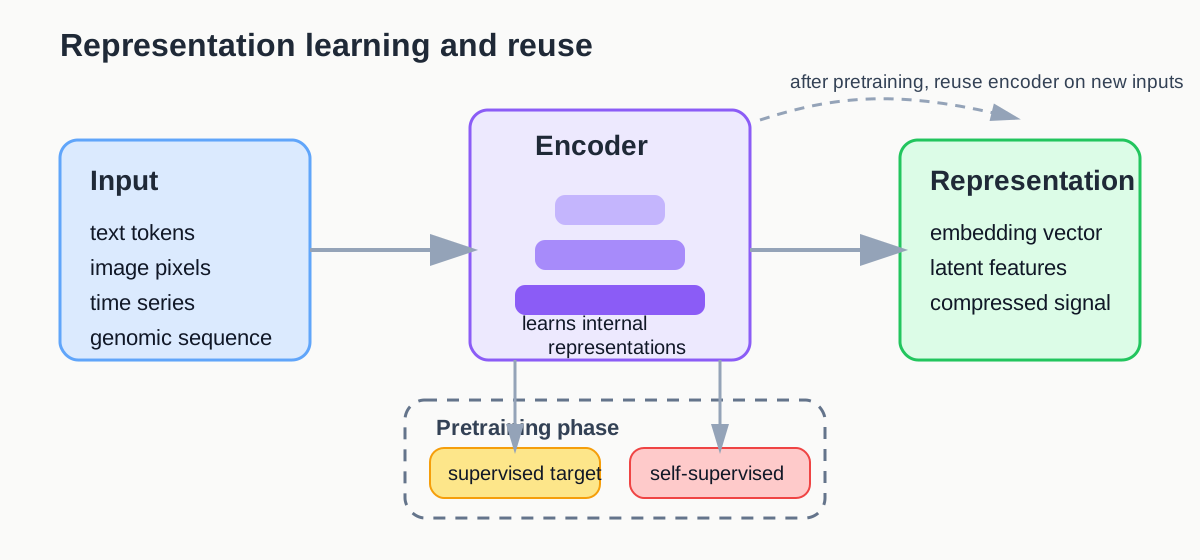
One useful plain-language definition is this: a representation is a way of transforming your data into a feature vector space where the patterns you care about become easier to separate, compare, or retrieve.
For text, that raises an important question: what exactly is being represented?
- a word embedding gives one learned vector per vocabulary item;
- a token embedding gives a vector for a word as it appears in a particular context;
- a sentence embedding gives one vector for the whole sentence or short document.
For this lesson, the most useful visual is the sentence-embedding view, because that is the pattern used in the text demo notebook.
A text to embedding example
An embedding model changes the problem. Instead of counting only visible tokens, it learns vectors that summarise how pieces of text behave across many examples.
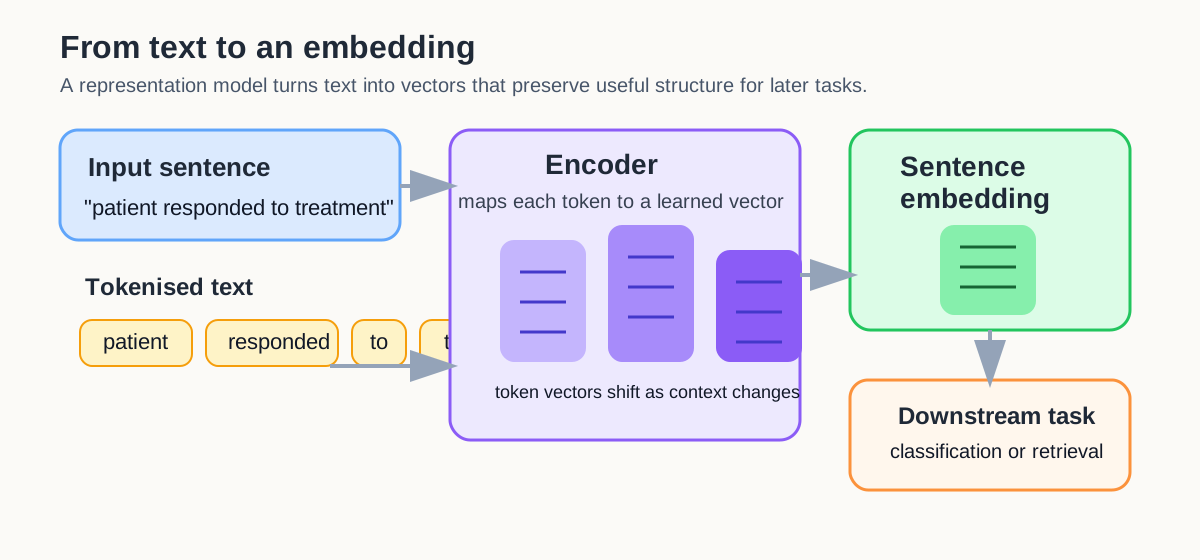
This is why embeddings are often described as learned representations: the model has learned a reusable way to encode inputs before the final classifier sees them.
Why the embedding can be meaningful
The key idea is not that the vector itself is magical. The key idea is that training pushes similar inputs toward similar internal representations.
For example, a useful text embedding should tend to place medically related sentences nearer each other than to space-related sentences, even if the wording is not identical.
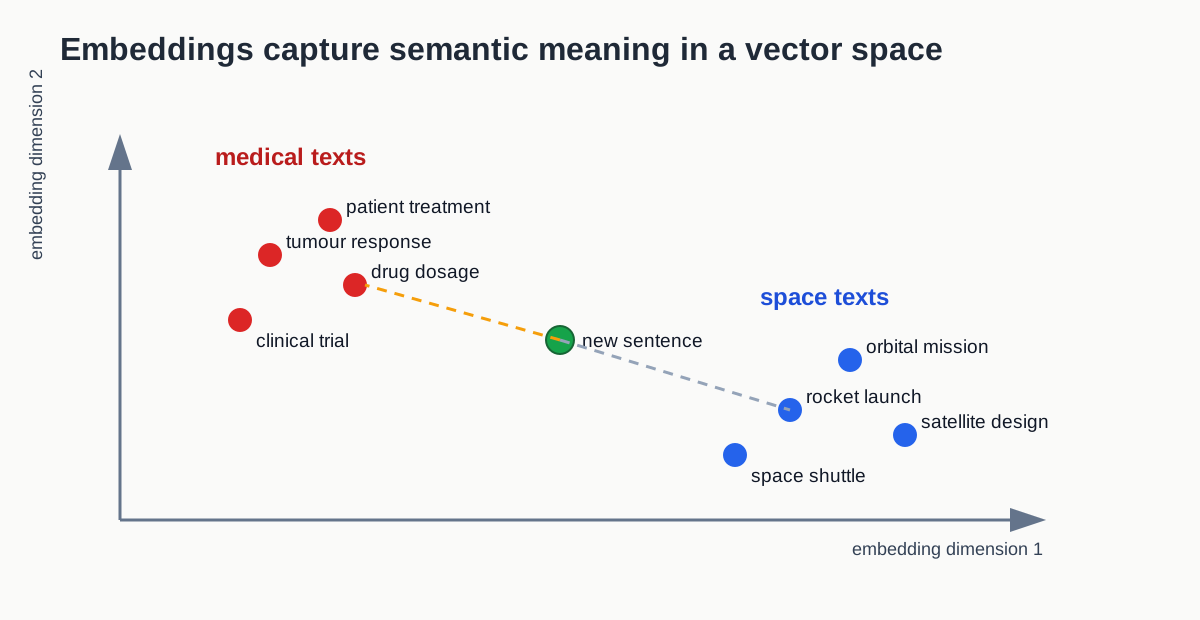
This drawing is only a sketch. Real embeddings may have hundreds of dimensions, and we usually inspect them only after projection. The important point is the geometry: closeness in representation space can correspond to semantic similarity or task-relevant similarity.
That is exactly what makes transfer learning practical. If a pre-trained encoder already places related inputs in sensible regions of the space, you can often train a much simpler downstream model on top.
When deep learning can help
Deep learning can be a good next step when:
- the data are unstructured or highly structured in raw form;
- important patterns are hard to hand-design as features;
- there is enough data, compute, or a strong pre-trained starting point;
- the data type naturally suggests a specialist architecture.
When deep learning is not the right next step
Deep learning is not automatically better.
- it is often harder to interpret;
- it can be slower to train and debug;
- it may need far more data than a workshop project has;
- it is easy to add complexity without adding insight.
That is why conventional baselines still matter. They tell you whether the extra complexity is justified.
Why transfer learning matters in practice
Most bootcamp projects do not have the data, time, or compute needed to train a large deep model well from scratch. That is why transfer learning is often the more realistic route.
Instead of learning everything from the beginning, you reuse a model or encoder that has already learned a useful representation somewhere else.
Transfer learning
Many workshop projects do not have enough data to train a deep model from scratch. In those cases, transfer learning is often the realistic option.
Transfer learning means starting from a model that has already learned a useful representation on a larger dataset, then adapting that learned representation to a new task.
Examples:
- sentence embeddings for text classification;
- pre-trained image models for vision tasks;
- pre-trained sequence encoders for genomic or protein sequences;
- pre-trained encoders for spectroscopy or multi-spectral signals such as NIRS when those data are treated as structured spectra or temporal signals.
Common transfer-learning patterns
There are several practical ways to use a pre-trained representation.
- use the encoder only and train a simpler downstream model on top;
- fine-tune part of the pre-trained model for the new task;
- compare a frozen feature extractor against a fully trainable model if you have enough data.
For workshop-scale projects, the first option is often the safest.
Matching transfer learning to the data
The question here is less about the architecture family itself and more about what kind of pre-trained representation is available.
| Data type | Useful transfer-learning direction |
|---|---|
| Text | sentence embeddings, transformer encoders |
| Vision | pre-trained image encoders, transfer features |
| Time series / signals | pre-trained sequence encoders when available |
| Spectra / specialist scientific data | domain-specific encoders or extracted embeddings |
| Tabular | usually better feature engineering first |
A practical decision rule
Ask these questions in order:
- Can a conventional model with sensible features solve enough of the problem?
- If not, is the limitation mainly about representation rather than the choice of classifier or regressor?
- If yes, is there a pre-trained representation or architecture that matches this data type?
If the answer to the third question is yes, transfer learning or a representation-learning approach may be the right next step.
Feature engineering or feature learning?
For your own project, answer:
- What representation are you currently using?
- What important structure might it be missing?
- Would that gap be better addressed by a hand-crafted feature or by a learned representation?
Is PCA representation learning?
PCA creates a lower-dimensional representation of the data, so it does learn a new representation in a broad sense. However, it is usually not what people mean by deep representation learning because:
- it is linear rather than highly expressive;
- it does not learn layered features through a neural network;
- it is usually unsupervised dimensionality reduction rather than deep feature learning.
Comparing PCA with learned embeddings
Discuss:
- In what sense is it similar to learned embeddings?
- In what sense is it different from neural-network-based representation learning?
Key points
- Feature learning means the model learns useful internal representations rather than relying only on hand-crafted features.
- Transfer learning is usually more realistic than training from scratch for workshop-scale projects.
- Transfer learning is about reusing a representation that has already been learned elsewhere.
- The most practical question is often not “should I use deep learning?” but “is there a useful pre-trained representation for my data type?”
- Conventional baselines still matter because they tell you whether the extra complexity is justified.